Optimizing the "Path to Hire": A Data-Driven UX Overhaul
SchoolSpring Job Board & Integrated ATS - 2.8M+ Monthly Active Users
The Challenge: A High-Volume "Leaky" Funnel
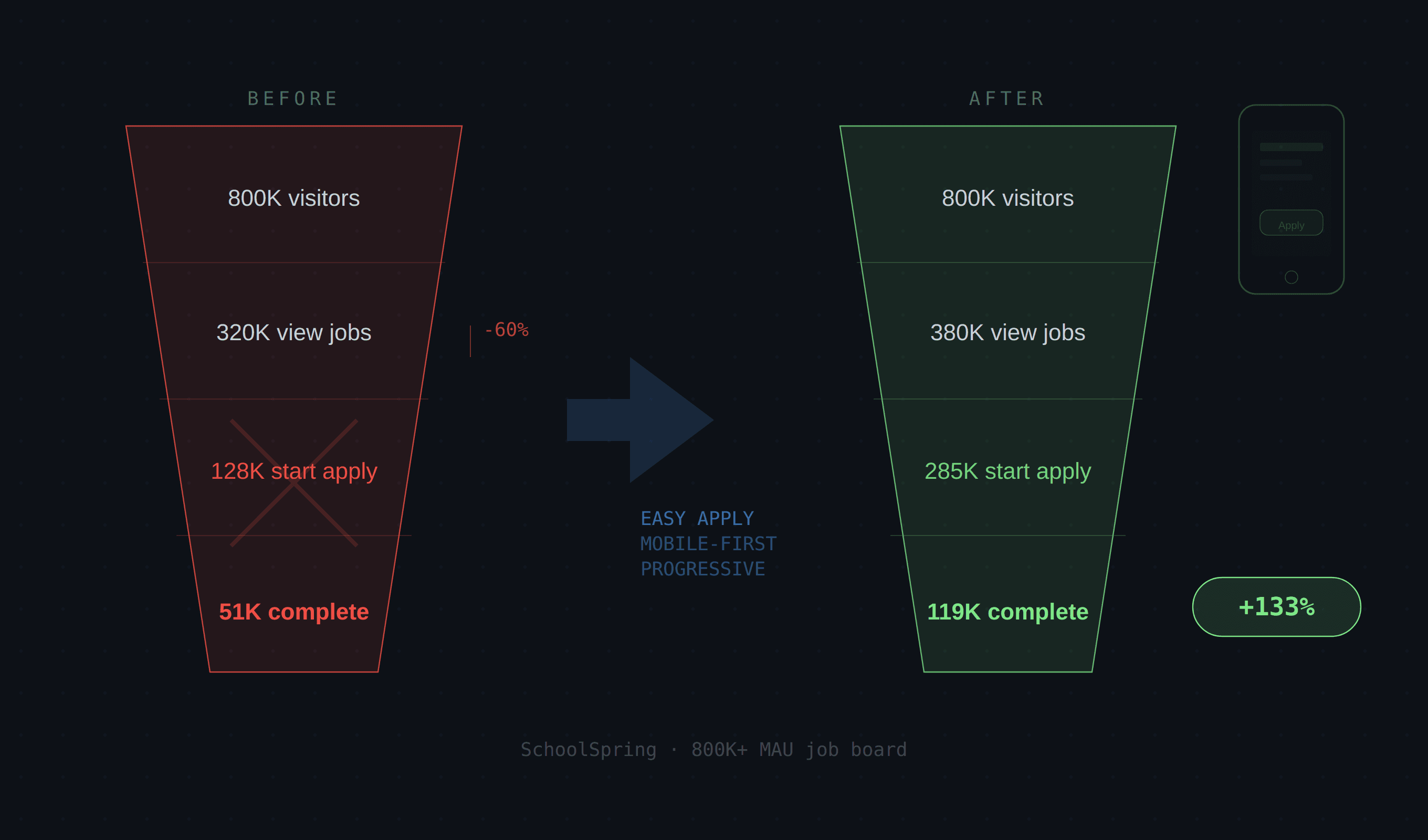
SchoolSpring, the K-12 education sector's largest job board, had a significant growth problem hiding in plain sight. With over 800,000 monthly active users, the raw traffic numbers looked impressive - but the conversion rate from "Job View" to "Successful Application" was falling well below industry benchmarks. High-intent candidates were abandoning mid-funnel due to "form fatigue" and repetitive data entry requirements.
The Problem: Legacy application flows were long, multi-page, and completely unoptimized for the 50%+ of users accessing the platform on mobile. Every drop-off was a lost hire for a district and a lost candidate for the platform.
The Goal: Increase application completion rates by streamlining the path from discovery to submission - without compromising the data integrity required by the backend ATS that districts depended on.
Diagnosing the Drop-Off: The Funnel Audit
Before proposing solutions, I needed to understand exactly where and why candidates were leaving. I ran a deep funnel audit using behavioral analytics to map the full candidate journey.
The Finding: 60% of all abandonment was concentrated at a single stage - "Required Documentation" (uploading teaching certificates, reference letters, and transcripts). Candidates hit this wall and quit.
The Insight: Returning users, who had already uploaded their credentials, still had to re-enter the same information for every new application. This was pure, preventable friction - a product failure masquerading as a user behaviour problem.
The Mobile Gap: Over 50% of sessions were on mobile, yet the form was designed for desktop. Native mobile patterns - auto-complete, date-pickers, stored credentials - were entirely absent.
The Action: Data-Driven Friction Removal
I led the end-to-end overhaul of the candidate journey, centered around four interlocking initiatives built around a new "Easy Apply" feature.
Easy Apply Launch: Spearheaded a streamlined, one-click application experience for returning users. By leveraging stored profile data - resumes, credentials, and preferences - candidates could skip redundant fields entirely and focus only on the job-specific "Killer Questions" that hiring managers actually needed.
Progressive Disclosure: For new users, I restructured the long-form application into a logical, multi-step flow. Essential eligibility questions were surfaced upfront; non-critical data collection was deferred to a post-submission profile enrichment step. This reduced the perceived length of the application by over 60%.
Mobile-First Redesign: Rebuilt form inputs from the ground up for mobile - native date-pickers, address auto-complete, credential upload via camera, and minimized free-text typing. The experience matched how candidates actually used the product.
ATS Integrity by Design: Every simplification was validated against the backend ATS data model. Easy Apply was not a shortcut - it was a smarter mapping layer. All submissions, regardless of path, populated the district's ATS with 100% data fidelity and mapped cleanly into existing hiring workflows.
The Impact: Doubling the "Path to Hire"
The results were immediate and measurable, transforming the platform's core efficiency metric for both candidates and the districts recruiting them.
+133% Conversion Lift: The percentage of candidates who successfully completed an application more than doubled - driven entirely by reducing friction, not increasing traffic spend.
60% Faster Applications: Reduced the average "Time-to-Apply" from 12 minutes to under 4 minutes. For mobile users, the improvement was even more dramatic.
Seamless ATS Sync: Zero regression in data quality. Every Easy Apply submission mapped perfectly into the district's ATS workflow, giving hiring managers a complete, structured candidate record without any manual cleanup.